Start from no
Anyone can bolt a chatbot onto a website now. That is exactly why the default answer should be no. When a feature gets cheap to add, people stop asking whether it should exist, and small-business sites end up carrying agents the way they once carried popups.
We build agent systems for a living, so this is not a skeptic's take. It is a builder's take: the same work that shows you what an agent can carry also shows you what it costs to supervise one. The difference is never the technology. It is the job you hand it.
Two definitions, because the words get blurred together. Automation runs the same steps the same way every time: a deploy, a scheduled post, a menu that updates everywhere from one file. An agent makes judgment calls: it reads a question or a prospect and decides what to do next. Most businesses asking for an agent need automation, and some need neither.
Where an agent earns its keep
An agent earns its keep when three things line up. The job repeats constantly, the answers live in material that already exists, and every miss costs you money. Two out of three is a hobby, not a hire.
White Thorn Gallery is the clean example. Steven Paul came to us with a jewelry and fine-art business and no store to sell it, so we built one from zero: a Next.js storefront with Stripe checkout wired end to end, and an on-site AI sales assistant that answers buyer questions. People hesitate before spending real money on jewelry, and nobody staffs a counter at midnight. The assistant does.
Look at why that one works: the questions repeat, the store already holds the answers, and at a jewelry price point an unanswered question is a shopper gone. If your customers do not hesitate before buying, or every answer needs a human judgment call, an assistant will sit on your site costing you attention.
When the agent does the work
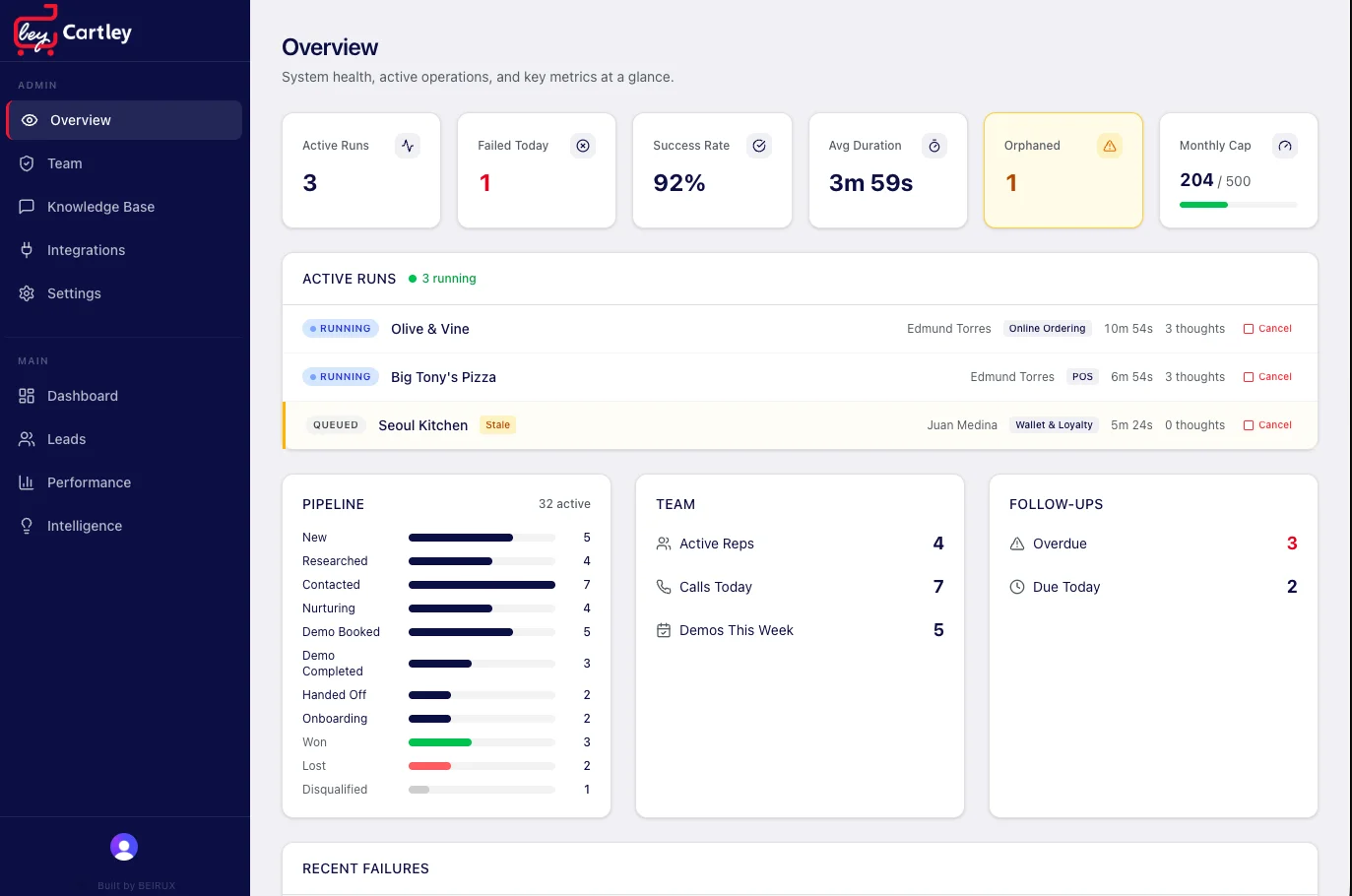
Answering questions is the light duty. The heavier case is an agent that does work, which is what Cartley is: a sales-intelligence platform we built, where agents research prospects and run playbooks so a sales team starts each conversation already informed. The logic holds because prospect research is hours of repeated manual labor, and repeated labor is the one thing agents reliably beat.
Here is the part nobody puts in the demo. Most of the engineering went into reliability, not intelligence: keeping agent runs idempotent so nothing fires twice, holding a run-cap window correctly across services, ingesting lead data cleanly enough to act on. The hard parts were the ones users never see.
Cartley ran a live pilot and is in active development, and we say that plainly instead of dressing it up as finished. It was our first agent-platform build, and its status is the most useful fact on this page: an agent platform that actually runs is an engineering project, not a checkbox in a page builder.
The babysitting test
An agent is not an employee. It does not notice when it is wrong, and it fails in ways that look like working: a confident wrong answer to a customer, a run that silently stops, stale data served politely. You usually find out from the person the agent was supposed to help.
So every agent carries a supervision cost that never reaches zero. Someone has to read the transcripts, keep the underlying data fresh, and confirm that last night's runs actually ran. Unless you hire for it, that someone is you.
The test, before anything gets built: estimate the hours per week the agent would save, then the hours per week it takes to supervise. If supervision wins, you did not remove a job from your plate, you added one. We run this test on our own ideas and it kills most of them, which is exactly what a good test should do.
The boring fix usually wins
Most of what small businesses want from an agent sits below the agent layer. For Adonis Market, the menu problem was not a judgment problem, so it got no agent: we turned scattered menus into a single structured source of truth, rendered out as clean design assets, so the menu stays consistent everywhere it appears. Same steps every time, nothing to supervise.
That is the order of operations we would give any owner. Fix the site first, because an assistant is only as good as what the site knows. Automate the mechanical work next: deploys, scheduled posting, menus that stay in sync. Add an agent last, and only where questions or research repeat daily and cost you sales when they slip.
And whatever you build, own it. Everything we ship goes to your accounts, your repos, your domain, so if an agent stops earning its keep you turn it off and walk away clean.
This is what we do. Bring us the job you want off your plate and we will build the right thing for it: an agent, an automation, or just a better page, decided by the same test we run on our own work. Talk to BEIRUX and get a straight answer, not a sales pitch.
Working on something like this? Tell us what you need or see the related service.