Five copies of the same menu
A menu never lives in one place. It's on the website, on the printed sheet by the register, in the social post announcing this week's specials, on the Google Business Profile. Every copy gets typed by hand, and every copy is a separate thing to update when a price moves.
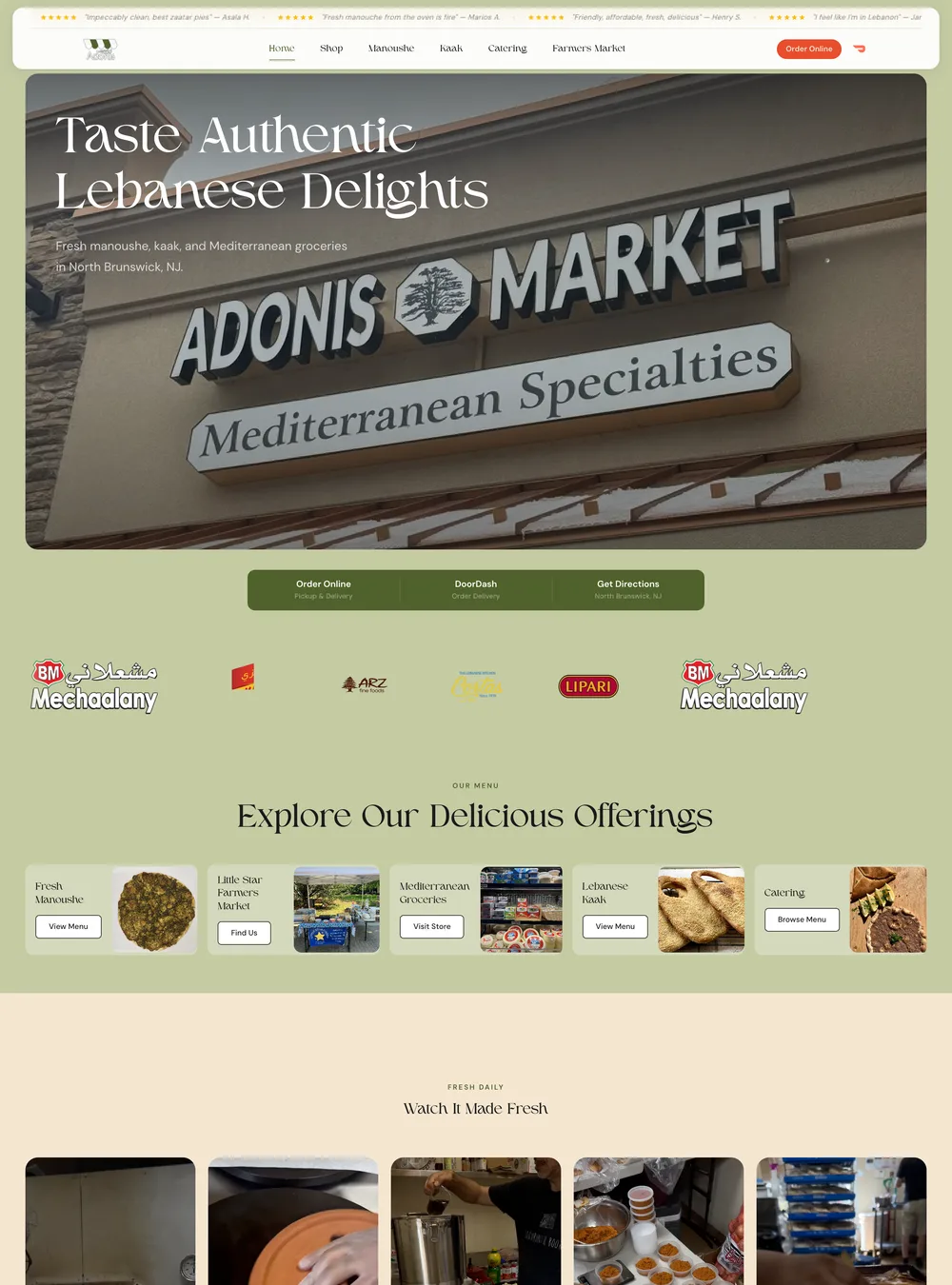
Adonis Market, a family-run Mediterranean grocery and catering business in North Brunswick, New Jersey, came to us with a version of this. They had a website but no real operation behind it: no structured menu, no email list, no managed social presence. Part of what they needed was easy to say and tedious to do by hand: menus that stayed in sync across everything they put out.
The menu becomes data
So we turned the menus into a single structured source of truth. Each item lives once, as data: a name, a description, a price, a section. Not a PDF, not a photo of the printed menu, not text pasted into a page builder.
That distinction sounds technical, but it decides everything downstream. A PDF can only be reprinted; data can be rendered. Once the menu is structured, the website, the print sheet, and the social template are all just different views of the same facts.
Rendered, not retyped
The site reads the menu straight from the source. The design assets that carry the menu are rendered from that same source, laid out in the brand system we built (palette, type, content templates), generated rather than redrawn. And the managed social program across Instagram, TikTok, Facebook, and Google Business Profile runs from one place.
So an update happens once. Change a price or swap an item at the source, and the site and the assets render the new version the next time they go out. Nothing has to be remembered, because nothing is a copy.
Copies drift, structure doesn't
None of this is really about menus. Any fact you publish in more than one place by hand will drift: hours, prices, the services you offer, what's in stock. Nobody re-edits five copies at nine on a Tuesday night. The copy that never got updated is the one a customer finds.
Drift costs you quietly. A wrong price on the site becomes an awkward conversation at the register; stale hours on Google become someone standing at a locked door. It never shows up as a line item, it shows up as trust leaking.
The fix is not discipline, it's structure. When a fact lives in one place and everything else renders from it, drift is not something you have to remember to prevent. It has nowhere to happen.
What belongs in one place
You can run this test on your own business in ten minutes. List the facts you publish in more than one place: menu, prices, hours, service list, delivery zones. For each one, ask where the master copy lives; if the answer is wherever it was last typed, you have found your drift.
For Adonis, the menu system is one piece of a larger build: a fast, auto-deploying website, the managed social program, an email newsletter, and a loyalty program with an in-store QR. It runs as an ongoing retainer, hosting and maintenance plus monthly social media management. The site is live and the four channels are connected and posting on a schedule.
There is no honest metric for a menu that stopped drifting, and we don't publish numbers we can't stand behind. The honest version is functional: the update happens once, and everything rendered from the source follows. That's the whole fix, and it's live for Adonis right now.
If your prices, hours, or menu live in more copies than you can confidently count, don't add a sixth place to keep updated by hand. Bring us the facts and we'll build the system that renders them everywhere, correctly, every time. Get in touch and we'll scope it.
Working on something like this? Tell us what you need or see the related service.